caliper, bitsize, gamma ray
Applications of Caliper, Bit Size, and Gamma Ray for Detecting Washout, Sand Production, Breakout, and Other Geomechanical Issues
These three logs are very useful together for evaluating borehole condition and geomechanical stability.
Caliper, Bit Size and Gamma Ray, each one tells part of the story, and when interpreted together, they help identify washout, breakout, caving, sloughing, sand production, and other wellbore stability problems.
Caliper
The caliper log measures the actual borehole diameter.
Main applications:
1- Detecting washout: if the borehole diameter is larger than bit size, part of the wall has been eroded or collapsed.
2- Detecting breakouts: if enlargement occurs in specific directions, it often indicates stress-induced failure of the borehole wall.- Identifying borehole instability: any irregularity, enlargement, or collapse can be seen on caliper.
3- Supporting interpretation of other logs: poor hole conditions can distort porosity, density, neutron, and resistivity logs.
Typical interpretation:
Caliper ≈ bit size = stable hole
Caliper > bit size = enlargement / washout / instability
Asymmetric enlargement = possible breakout
Bit Size
Bit size is the nominal diameter of the drill bit, meaning the designed hole size.
Main applications:
1- Reference for comparing with caliper
If caliper > bit size, it suggests washout, sloughing, or hole enlargement
Helps evaluate how much the borehole has changed after drilling
Important note: Bit size is not a measured log; it is the expected hole diameter. Without bit size, caliper interpretation is incomplete.

Gamma Ray
Gamma ray mainly indicates lithology and shale content, but it is also very useful for geomechanical interpretation.
Main applications:
1- Identifying shale-prone intervals
2- Recognizing zones more likely to be unstable
3- Shale sections often show swelling, sloughing, or washout
4- In many wells, high gamma ray intervals correlate with enlarged borehole diameter
Typical interpretation:
High GR + high caliper = likely shale instability, swelling, or washout
Low GR + high caliper = possibly unconsolidated or weak clean-sand formation
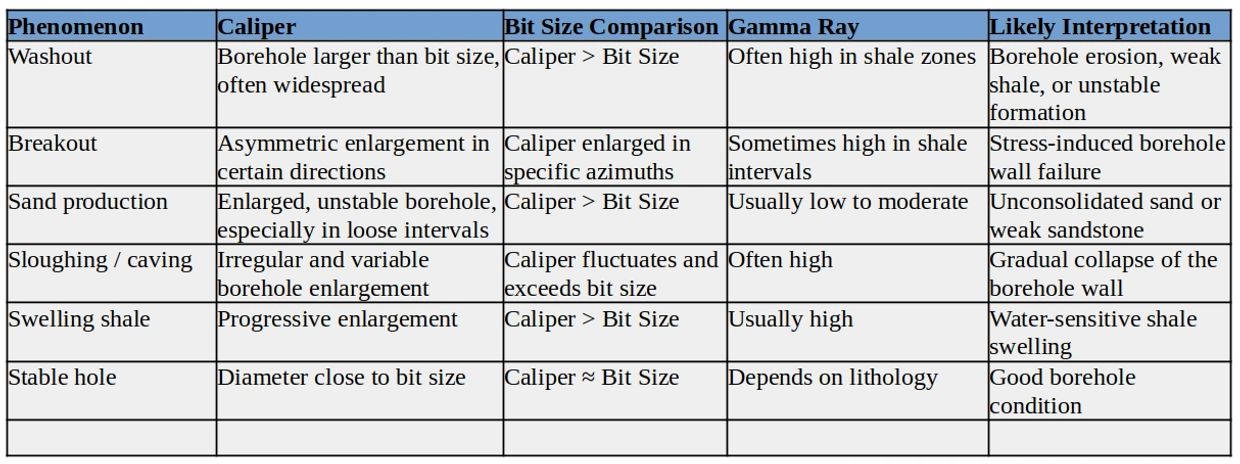
Detailed Explanation of Common Issues
Detailed Explanation of Common Issues
1) Washout
Washout means part of the borehole wall has been eroded, making the hole larger than expected.
Causes:
Weak shale
Poor mud properties
High hydraulic erosion
Long exposure time
Loose or poorly consolidated formation
Indicators:
High caliper
Often associated with high GR if shale is the cause
Can degrade the quality of other logs
2) Breakout
Breakout is caused by stress concentration around the borehole wall and appears as directional enlargement.
Indicators:
Multi-arm caliper shows enlargement in specific directions
Usually related to in-situ stress conditions
Especially important in deviated wells
Uses:
Estimating stress orientation
Helping optimize mud weight and well trajectory
3) Sand Production
Sand production occurs when unconsolidated sand or weak sandstone enters the borehole.
Indicators:
Caliper greater than bit size
Unstable borehole wall
GR usually lower than in shale zones
Often associated with completion and production problems
Important:
High caliper alone is not enough to confirm sand production; lithology and other logs should be considered.
4) Sloughing / Caving
This refers to gradual collapse of borehole fragments into the wellbore.
Indicators:
Irregular caliper readings
Common in shale intervals
Often associated with high GR
A frequent form of borehole instability